
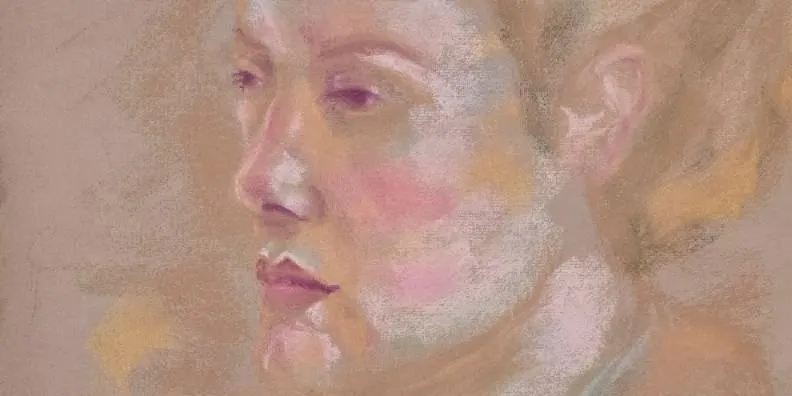
Is owning art still worth it?
We are now saturated with art-like experiences, from the quirky cafés to social media and now even AI, all of which promise art for free. But do they deliver? And is there still something special about owning art?
I started collecting art ever since I could afford my first original painting, and to this day I’m obsessed with it. I’ve owned this artwork for 10 years and it’s still a part of my home and of my identity. It says something about me and the moment I could afford it, but more importantly, I’ve never grown tired of it. Not once did I think, oh, this doesn’t do it for me anymore, or that I should get a different one, or even a different colour, perhaps? It’s because there are so many layers to this painting, that I always find another nook and cranny that I might have missed, even after 10 years of looking at it! And the same goes for my whole collection.
A painting can’t merely be a window into some-thing, but rather a window through someone. I’m seeing something that the artist saw, in the way they saw it, in that moment, or collection of moments, that could be expressed in the way that it has been or chosen not to.
For example oil paintings are almost alive in their layering and how light travels through those layers. I’m being pulled into a multisensory experience that a flat image, or worse, a digital image, doesn’t seem able to replicate. Not to mention the distortion of size. Most people, and I include myself in that, don’t actually know the true size of original masterpieces. So when you go to the museum, you might even be disappointed, when you realise that the “Mona Lisa”, or ”The Girl with the Pearl Earring" aren’t actually as big as the marketing might have led you to believe. Worse still, this distortion of space is taken to extremes on social media. There, works made in tiny notebooks, can be made to look monumental, while other works are presented at scales they could never physically sustain.
Such a distortion might not seem important, but what people don’t understand is that certain brushstrokes cannot physically be done at bigger sizes. There is a natural limit to our maximum freedom of artistic expression. Think of it as the law of diminishing returns, the bigger the canvas, the more you can express yourself, up to a point, after which it starts to diminish.
I would challenge anyone to go from Pinterest or Instagram to an actual art dealing website, gallery or real artists’ website. The differences are striking: in quality, contrast, what is truly achievable at a given size, and what cost. However, these distortions are now so ingrained into our sense of normality, that I even had people come up to me at art fairs to ask me if I had “that original in a smaller size”. Or a bigger size, for that matter, not realising that the size is just as much an integral part of the artwork, as the artwork itself. I find that working with life models, with its limited time frame, places immense restrictions on what is possible, on what size, and with what materials.
Ultimately this very experience of art is what artists are trying to share, and sell, and it is becoming increasingly difficult to do so, as everything gets distorted and mistranslated through a digital lens that is: insipid, “agravitational”, and dimensionally distorted.
To mitigate this, artists are digitally editing their works, increasing contrast, and saturation, especially on social media, where the platform itself almost requires you to do so. This further skews any natural relationship to colour, value, and ultimately meaning of that work.
I’ve been at exhibitions where the artists also sold prints, and the prints looked “better” than the original, because the contrast was tweaked and saturation pumped, something that you can’t do with two clicks when you’re actually painting.
Because, to increase these features in a real painting, one needs to cross entire psychological thresholds. Such changes become permanent and so, very careful deliberations must take place. If you overdo it, it’s simply overdone, and in many instances you might just as well throw away the whole painting. So caution is an inbuilt function in any physical painting, and that caution adds to the very tension of the painting itself. This becomes part of the dialogue, not merely a visual feature to over-satisfy the retina for an extra millisecond. It is but a part of the very inner struggle of the artist, as you’re desperately trying to find a balance between all these different dimensions.
All of this has now been reduced to very linear “comparison” in the online discourse, one that is also overcrowded by bots, rather than humans. And to top it all off, this discourse happens within seconds. Glancing over artworks, which must capture your attention with high contrast and saturation, really pales beside experiencing art in person. If you own an artwork, you won’t just glance over it, but it will become an object of introspection for years to come. You build an entire relationship with its layers, angles and attitudes. Therefore, depth cannot come at a glance, it simply must take its time.
Time that has seemingly run out entirely on social media, as we rush from one reel to another, ever more quickly.
It would seem, at least, that we have solved one issue: the distribution of art, but have we? Is distributing tiny thumbnails the same as distributing real art? I would argue not.
We are, most importantly, not paying attention to what we are losing in the process: the experience of art itself. Part of that experience is also searching for art, rather than letting algorithms feed you more of the same thing.
Thus, owning art matters, because a real artwork is not just an image, but a sustained and interactive physical relationship to another person’s seeing, scale, labour, and presence.
Where Art meets Awareness.


